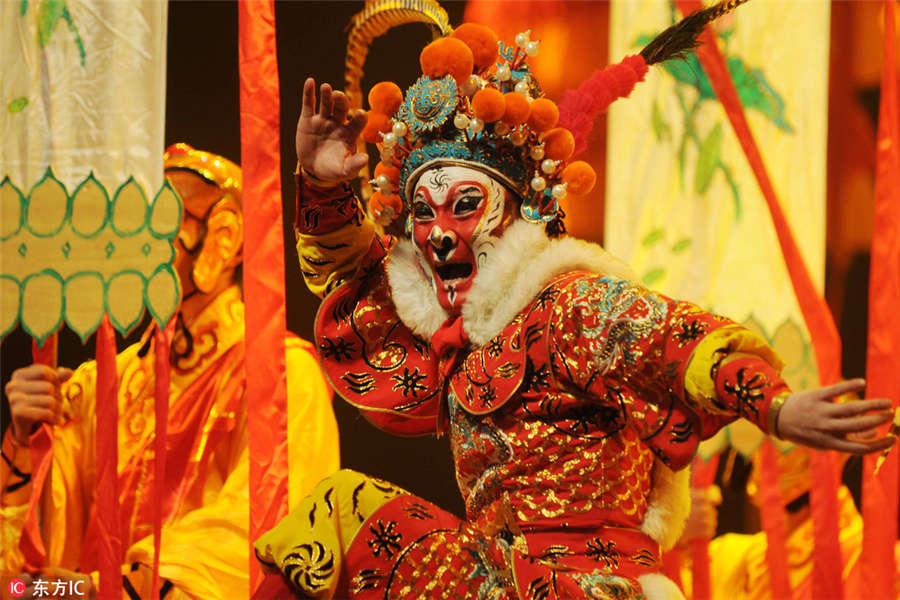
Sun Wukong
Introduction
Sun Wukong, famously known as the Monkey King, is a famous figure in Chinese folklore and literature, celebrated for his remarkable attributes of strength, intelligence, and a host of magical abilities. He is predominantly featured in the 16th-century Chinese novel "Journey to the West," penned during the Ming Dynasty (1368-1644) by Wu Cheng'en. This legendary tale chronicles the epic journey of the Buddhist monk Xuanzang, also known as Tang Sanzang, as he travels to India to acquire sacred Buddhist scriptures. Accompanying him are three loyal disciples: Sun Wukong, Zhu Bajie, and Sha Wujing, with Sun Wukong being the most prominent due to his dynamic character and powerful skills. The Monkey King is depicted as a rebellious and mischievous yet ultimately benevolent figure.
Origins and Mythology
Sun Wukong is born from a stone atop the Mountain of Flowers and Fruit, gaining supernatural attributes through Taoist practices. His rebellious nature leads him to challenge the Heavenly Kingdom, leading to his eventual imprisonment under the Five Elements Mountain by Buddha. After 500 years, he is released to accompany the monk Xuanzang on a pilgrimage, during which he uses his powers to protect his master and defeat numerous demons and adversaries.
Character Traits and Abilities
Sun Wukong is celebrated for his intelligence, cunning, and martial prowess. He excels in a form of combat that combines physical combat skills with magical abilities. Among his most notable skills is the ability to transform into 72 different forms, granting him versatility in various situations. He wields the Ruyi Jingu Bang, a magical staff that can change size at will. His ability to travel vast distances in a single leap ("cloud somersault") is another of his famed abilities.
Cultural Impact and Adaptations
The influence of Sun Wukong extends far beyond the pages of "Journey to the West". He has been featured in countless adaptations, including television series, films, and animations across Asia. Internationally, Sun Wukong's character inspired the creation of Son Goku in the Japanese manga and anime series "Dragon Ball", demonstrating his global cultural impact.
In recent years, the video game "Black Myth: Wukong" has further popularized his story. Developed by the Chinese company Game Science, the game has sparked international interest and is seen as a significant cultural export, showcasing elements of Chinese mythology and folklore through cutting-edge gaming technology.
Artistic and Theatrical Representations
Sun Wukong's adventures have been depicted in various art forms, including Peking Opera, known for its elaborate make-up and symbolic performances. The character is a popular subject in traditional Chinese arts, such as dough modelling, where artisans craft figurines based on his likeness and stories.








